The post March 13th: A Big Day for the U.S. appeared first on Global Footprint Network.
]]>
At least it’s not Friday the 13th—but on March 13, the U.S. will reach its Overshoot Day for the year 2025.
What is this Overshoot Day?
If everyone in the world lived like U.S. residents, humanity would have exhausted its annual ecological budget by March 13. For the remainder of the year, we would be depleting the planet’s resources faster than they can regenerate. March 13 is one of the earliest dates on the Overshoot Calendar, highlighting the disproportionate ecological footprint of the United States.
The U.S. is fortunate to be endowed with abundant regenerative resources—what we call biocapacity. Per person, it has more than twice the global average of these resources. Yet, despite this wealth, U.S. demand still surpasses what its ecosystems can sustainably provide. At its current rate of consumption, the country would deplete its entire annual regenerative resource budget by the end of June—within just six months. This is its Deficit Day. It’s important to note that some of this biocapacity is also essential for sustaining wildlife.
Both Country Overshoot Day and Deficit Day are critical because they reveal different facets of the same story: our relationship with the regenerative resources that underpin all economic activity. The planet’s regenerative capacity defines the limits of sustainable consumption—whether it’s food, fiber, timber, or even fossil fuels. Fossil fuel use, for instance, is constrained not by the amount of oil or coal remaining underground, but by the biosphere’s ability to absorb carbon emissions. Similarly, mining is limited not by the availability of minerals, but by how much of the biosphere we are willing to sacrifice for extraction and processing.
Why does it matter?
Ignoring resource security and pretending ecological overshoot doesn’t exist leads to self-defeating decisions. It channels investments into assets that will have little utility—and therefore little value—in the future we can already foresee.
This makes this year’s U.S. Overshoot Day particularly significant. Like most nations, the U.S. lacks robust resource accounting systems. Compounding this issue, the current administration is actively dismantling the scientific capacity of government agencies tasked with tracking climate and resource trends. At the same time, it is discouraging a transition away from fossil fuel dependence, further undermining the country’s long-term resilience. Clinging to resources with a shrinking future means investing in infrastructure that will become increasingly obsolete in a world shaped by climate change and resource constraints.
Ironically, the administration claims to prioritize environmental quality. In his March 4 speech to Congress, the president emphasized his commitment to improving air and water quality. Yet, simultaneously, his administration has proposed a 65% budget cut to the Environmental Protection Agency (EPA), the very body responsible for safeguarding air and water. Additionally, there is a strong push to roll back environmental regulations, many of which are designed to protect public health and ecosystems. The administration has also been vocal about its support for fossil fuels and its resistance to renewable energy development.
What can you do?
Ultimately, the winners in a future shaped by climate change and resource constraints will be those who recognize the reality of these challenges and strategically direct their investments toward opportunities that will retain long-term value. This approach not only provides a roadmap for sustained prosperity but favors those who proactively prepare for the predictable shifts ahead.
Recognizing the realities of climate change and resource constraints is therefore not pessimistic—it’s empowering. With the right tools and mindset, we can build a robust and thriving future. As we’ve outlined through our “Power of Possibility” platform, the greatest economic opportunities lie with those ventures that create value while reducing global overshoot.
Here’s what you can do: Whenever you get caught in a conversation about climate change or the futility of environmental action, try this. Turn it into an inquiry. Ask your counterparts what kind of assets they believe are more likely to gain in value, and examine with them how that outcome will that be shaped by the trends of more climate change and increasing resource constraints. In other words, as cities, companies and countries invest in their development, which bets are more likely to be successful?
The good news is that we do not need to wait for others. Each household, city, company, or country can choose their own bets.
What’s not to like? Let’s build a thriving future.
The post March 13th: A Big Day for the U.S. appeared first on Global Footprint Network.
]]>The post The Global Footprint Network approach appeared first on Global Footprint Network.
]]>
Humanity’s escalating ecological overshoot, demanding over 75% more from nature than ecosystems can regenerate, has triggered climate disruption, biodiversity loss, and resource depletion, undermining global stability.
While climate change understandably dominates environmental discourse, it is often framed as a “free-rider problem.” Under this mindset, individuals, businesses, and nations perceive that they are being asked to make sacrifices for the global good, which breeds resistance rather than enthusiasm. Free-rider logic appears everywhere: for example, a Californian who gives up their car to reduce CO₂ emissions will not significantly lower the chance of their own house burning down in a wildfire.
Because free-rider problems suffer from misaligned incentives, they are notoriously difficult to solve.
But is our environmental challenge truly defined by free-rider dynamics?
Global Footprint Network is not convinced. We take a different approach, one that reveals most environmental challenges are not free-rider problems but are closely tied to actors’ own interests. Rather than focusing solely on carbon emissions, we invite a broader perspective: ecological overshoot. This means looking not just at carbon but at biocapacity, the regenerative capacity of ecosystems.
This shift reframes the crisis as a resource security challenge, one that directly affects the stability and resilience of cities, companies, and countries. Resource insecurity is a major consequence of climate change. A shifting climate will strain agricultural systems, while the transition away from fossil fuels will disrupt resource inputs that economies have long relied on. Yet failing to transition will accelerate climate change, forcing an even more abrupt and costly shift later.
Resource security is therefore deeply intertwined with climate change. Paradoxically, framing the issue around resource security makes solutions more actionable. While cutting carbon emissions often feels abstract and collective, ensuring reliable access to resources is an immediate, tangible concern for decision-makers.
By emphasizing resource security, we align environmental imperatives with economic and strategic self-interest. People feel their “skin in the game.” Preparing for an overshoot-constrained future becomes not just a moral obligation but a pragmatic necessity: it delivers economic advantages, strengthens resilience, and ensures long-term prosperity.
We also believe in the power of early wins. Demonstrating that resource security efforts yield clear, measurable benefits attracts attention and builds momentum. It signals opportunity to key stakeholders and accelerates engagement. This is why we prioritize practical examples that showcase immediate advantages, rather than starting with commons-based challenges like atmospheric pollution or deep-sea fishing, which require broad international cooperation and long-term commitments. By focusing first on areas where individual actors can see direct gains, we create a positive feedback loop, emphasizing their advantage rather than sacrifice.
More resources:
- Another way to hold the problem
- Skin in the game
- What is missing?
- Global Footprint Network communications approach
- Global Footprint Network history
- Global Footprint Network offering
The post The Global Footprint Network approach appeared first on Global Footprint Network.
]]>The post 🎵 I love Paris… 🎵 appeared first on Global Footprint Network.
]]>The administration has also made its disdain for ESG (environmental, social, and governance) assessments in the corporate world abundantly clear. It has shown contempt for corporate commitments to reduce dependence on fossil fuels and is even exploring ways to label ESG initiatives or corporate decarbonization strategies as “anti-competitive collusion.” This includes threats to subpoena managers and board members of companies pursuing such strategies.
One might question how a government with libertarian leanings justifies interfering with corporate intentions—unless, of course, those intentions are criminal. But the larger issue is whether such efforts benefit companies or society at large. We believe that ignoring the realities of ecological overshoot is not only counterproductive but also economically damaging. Companies that fail to prepare—particularly in terms of their product offerings—for the inevitable challenges of climate change and resource constraints are undermining their own futures.
In essence, the U.S. is spending public resources to blind itself to an unavoidable reality, recklessly undermining its ability to respond and prepare effectively for a trend inaction makes even more likely, if not certain.
The post 🎵 I love Paris… 🎵 appeared first on Global Footprint Network.
]]>The post “Why study for a future, which may not be there?” appeared first on Global Footprint Network.
]]> Greta Thunberg stunned the COP Climate Conference in Poland in December 2018 with her clarity and honesty. Just 15 years old, she told the UN—”You say you love your children above all else, and yet, you’re stealing their future in front of their very eyes.”
Now she is 16 and has stepped up her game. After being on school strike herself every Friday since August 2018, she has inspired school strikes around the world. The next big one is March 15th.
Why are school children striking? Simply because:
School children are required to attend school. But with the worsening Climate Destruction this goal of going to school begins to be pointless.
—Why study for a future, which may not be there?
—Why spend a lot of effort to become educated, when our governments are not listening to the educated?
(from https://fridaysforfuture.org/)
It impresses me that children can access deeper truth with such clarity, and vocalize it rather than repress it. This is something to which we all, young and old, could draw inspiration from. It is time to address our environmental crisis instead of normalize it.
Demanding more than what our one planet can provide (from food production to carbon absorption) is not a long-term option. (How many planets does it take if everybody lives like you? Easy to find out—just visit www.footprintcalculator.org.) The only true choice is how well we want to live given the one-planet context.
Foresight and innovation
While our planet is finite, human possibilities are not. The transformation will succeed by applying people’s greatest strengths: foresight and innovation. We can address our food system—already today, food production takes up half of the planet’s renewable capacity. We can also rebuild our energy systems, and make them renewable and one-planet compatible. We can support smart urban transformation, given that 80% of the population will soon reside in cities. And then it matters how many we are. Investing in smaller families provides not only short-term social benefits for the next generation (better education and health), but also dramatic ecological benefits in the longer run.
What do the leaders of 2050 want today?
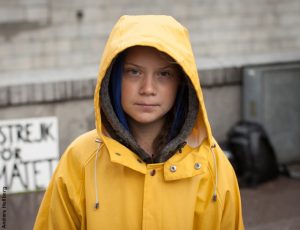 As Greta and her friends have pointed out, the rapid transformation called for in order to comply with the Paris Agreement requires moving out of fossil fuels way before 2050. Given that, who are the most important people to engage with? To me it is clear: those born after 1985. Still under 65 years old in 2050, they are the ones who will still be in the workforce; they will be the captains of Spaceship Earth in 2050.
The question to them is simple: What do YOU want, given the fact that we live on this one, overstretched planet? What do you want so your generation can still have a chance of being prosperous? Forget about what “we should do.” That’s not how you move mountains. The only thing that matters, and that has transformational power, is what you really want.
Here is my offer to the ones born after 1985: Tell us what you want, invite us to help you, and tell those who are not willing to build a successful future with you on our one and only planet to get out of the way.
Do you want to take part in the school strike for the climate? See you there!
More resources
Greta Thunberg’s TedTalk: www.ted.com/speakers/greta_thunberg
Greta Thunberg’s Twitter page: https://twitter.com/GretaThunberg
School strikes: https://en.wikipedia.org/wiki/School_strike_for_climate
Worldwide: https://fridaysforfuture.org/
USA: https://www.youthclimatestrikeus.org/platform
Australia: https://www.schoolstrike4climate.com
The post “Why study for a future, which may not be there?” appeared first on Global Footprint Network.
]]>The post “The Ecological Footprint is a fair metric for Slovenia to achieve its climate goals.” appeared first on Global Footprint Network.
]]>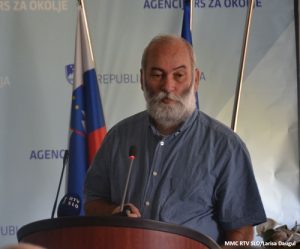 On September 11, Global Footprint Network Senior Scientist Alessandro Galli and Slovenian sustainable development expert Jernej Stritih presented their preliminary report on Slovenia’s Ecological Footprint at a public event hosted by the Slovenian Environment Agency in Ljubljana. Jernej Stritih spoke to us from Bovec, where he runs his consulting agency, and shared his insights about the process his country has embarked on.
What are Slovenia’s goals for sustainable development?
In 2017 the government made a commitment to reducing Slovenia’s Ecological Footprint 20% by 2030. Slovenia is also bound by the European Union’s goal, under the 2015 Paris Climate Accord, to reduce carbon emissions 40% by 2030. The two targets are obviously connected. We’re currently in the process of studying that interplay and identifying the policies that can help us achieve both.
Why did Slovenia choose the Ecological Footprint while planning for policies related to sustainable development?
The Paris Accord mentions only carbon emissions. But we feel that this alone is too narrow, because reporting our national emissions omits a large part of the total emissions that our consumption is responsible for. Consuming imported goods is tantamount to exporting emissions to countries that produce what we consume. More and more sustainability experts and activists in Slovenia have been advocating for the Ecological Footprint because we see it as a fair metric that takes trade into account. It makes it possible to track and report accurately all the resource use Slovenians are responsible for around the world.
What did the preliminary report on Slovenia’s Ecological Footprint bring to light?
We are working as consultants commissioned by the Ministry of Environment looking at three major sets of measures presenting opportunities for reducing the Ecological Footprint and for sustainable development: transportation, energy, and forest management. More specifically, we’re looking at promoting the use of electric vehicles in conjunction with decentralized solar power generation and battery storage , and ensuring energy efficiency for commercial buildings. We already achieved a 50% reduction of carbon emissions from residential buildings between 2000 and 2015, in large part thanks to improved insulation triggered by subsidies. Gazole and gas were also substituted by firewood – a policy that has relied on the tradition of sustainable forest management. Most of the biocapacity in Slovenia is provided by sustainably managed forests and we are analysing how the productivity of forests can be further increased. This is complicated by the emerging negative impacts of climate change in terms of extreme weather, drought and bark beetle expansion, leading to increased sanitary harvesting in the recent years. More active silviculture will be required to improve the resilience and carbon sequestration of the forests.
What are the next steps?
We’re still working on finalizing calculations to quantify the expected impact of the measures. We expect the completed report with accurate data to be available before the end of this year. Then the Ministry of Environment will begin the measures-design phase in partnership with us, relying on our findings to push for regulatory action and for channeling investment of the funds dedicated to combating climate change. I expect this work will take a couple of years. Eventually, the Ministry will be in charge of implementing those measures. We’re also going to develop a network of experts, including within the government – I’m thinking especially of the Office of Statistics – who understand thoroughly how data is to be collected and reported. Indeed, the work will be meaningless if we can’t track impact and progress accurately. We can reasonably expect to start seeing impact within five years from now.
What are the hurdles?
The energy lobby is a powerful force. They’ve been pushing for a new nuclear plant and fighting against decentralized solar. They muddy the waters, spreading the myth that the net Foootprint of solar is higher than that of nuclear because of the panels’ lifecycle. Fortunately, they’re losing the cost argument these days. The road infrastructure lobby is another one we’re going to have to contend with. Last but not least, it will come to political will: can the government make sustainability a priority over the long-term? The current Minister of the Environment Jure Leben has a 15-year career as a sustainable development professional. In fact, I hired him as a young expert, back in 2009 when I was leading the Climate Change Office in the government. But governments are prone to change, especially when they rely on a coalition of five political parties as is the case today in Slovenia.
What are some encouraging signs?
Slovenians are strongly in favour of environmental protection. They are interested in reliable information, such as what the Ecological Footprint brings. They’re also more and more familiar with the Ecological Footprint: this year’s Earth Overshoot Day has been a huge media event in Slovenia, thanks in part to the great efforts of the nascent WWF office in the region and other NGOs. This month’s meeting was open to journalists and received very good media coverage. I was even interviewed on national television to talk about the Ecological Footprint and how it is the metric we need to achieve our development goals!
The post “The Ecological Footprint is a fair metric for Slovenia to achieve its climate goals.” appeared first on Global Footprint Network.
]]>The post Saint Louis Climate Summit appeared first on Global Footprint Network.
]]>The panel is Monday, April 23 from 10:45 am – 11:45 am.
For more information and to purchase registration to the event, please click here.
The post Saint Louis Climate Summit appeared first on Global Footprint Network.
]]>The post Three Visualizations of Footprint Trends, 1961-2014 appeared first on Global Footprint Network.
]]>In the first visualization below, check out the dramatic change in Footprints by region over time, with Asia skyrocketing by Europe and North America. (Click the play button in the lower left corner of the graphic.)
<iframe width=”400″ height=”325″ frameborder=”0″ scrolling=”no” marginwidth=”0″ marginheight=”0″ src=”https://www.google.com/publicdata/embed?ds=z4gmer1hc5n8o7_&ctype=c&strail=false&bcs=d&nselm=s&met_y=eftot&scale_y=lin&ind_y=false&idim=region:5002:5142:5150:5419:5009:5021&ifdim=region&hl=en_US&dl=en_US&ind=false&icfg”></iframe>
The second visualization below shows how large country Footprints change over time. Notice the United States and China. (Click a bar to identify which country it represents.)
The third visualization below plots the Ecological Footprint per person of countries on the x-axis and U.N. Human Development Index (HDI) on the y-axis. It shows one piece of good news: The quality of life is improving around the world, as measured by HDI, a composite index based on education, longevity, and income. A score of 0.7 is “high human development.” However, the graph also shows that as HDI increases, so does the Ecological Footprint per person. (Click the play button in the lower left corner. Click on a dot to see which country it represents.)
Explore our National Footprint Accounts 2018 at http://data.footprintnetwork.org.
Download our free Public Data Package at www.footprintnetwork.org/public.
The post Three Visualizations of Footprint Trends, 1961-2014 appeared first on Global Footprint Network.
]]>The post Has humanity’s Ecological Footprint reached its peak? appeared first on Global Footprint Network.
]]>The levelling of the total global Ecological Footprint in 2014, the latest year with a complete U.N. data set, may be due to a flattening of demand in China combined with slight decreases of the Ecological Footprints in high-income countries. This led to an average per-person Ecological Footprint worldwide of 2.8 global hectares, compared to 1.7 global hectares per person of available biocapacity. (Biocapacity represents the productivity of the Earth’s ecological assets. A global hectare is a biologically productive hectare with world average productivity.)
Eighty-six percent of the world’s population lives in a country with an ecological deficit. A country runs an ecological deficit when its residents demand more from nature than the country’s ecosystems can regenerate. Seventy percent of humanity lives in a country with an ecological deficit and below-average income, and therefore are unlikely to be able to buy themselves out of the resource crunch.
“Clearly, resource security is becoming an ever more significant factor for securing countries’ long-term economic vitality and resilience. Unfortunately, this is still not recognized by mainstream development policy, much to the detriment of low-income populations,” says Dr. Mathis Wackernagel, CEO of Global Footprint Network.
Global Footprint Network launched the National Footprint Accounts 2018 and several new data tools at an event during Skoll Week at Oxford. In addition, Global Footprint Network is presenting its key results on Monday, April 16, at George Washington University in Washington, D.C.
Highlights of the new Footprint data and tools include:
- The National Footprint Accounts 2018 Edition includes time series data for 17 countries that were not provided in the past due to data quality issues. This includes Bahrain, Equatorial Guinea, Qatar, United Arab Emirates, Kuwait, and Kazakhstan.
- Interactive world maps for Footprint and biocapacity at data.footprintnetwork.org.
- Sixty new ways to sort countries on the downloadable Public Data Package, including post-USSR countries, BRICS countries (Brazil, Russia, India, China, South Africa), OPEC countries, countries with the greatest GDP per capita growth from 1997 to 2007, high inflation countries, high population growth countries, and low-income countries facing severe resource constraints.
- Trend graphs for all countries, including for the compositions of the Ecological Footprint.
Additional features available for a fee include “nowcasting” capabilities to forecast results to 2018 and licenses for more detail on countries’ demand by consumption activities.
Human Development
One piece of good news is that quality of life is improving around the world, according to the UN Development Programme. The 2016 Human Development Report (the latest published) found that the U.N. Human Development Index (HDI) improved significantly across all regions from 1990 to 2015. HDI is a composite index based on three components: education, longevity, and income. A score of 0.7 is “high human development.” The graph below shows that as HDI increased, so did the Ecological Footprint per person.
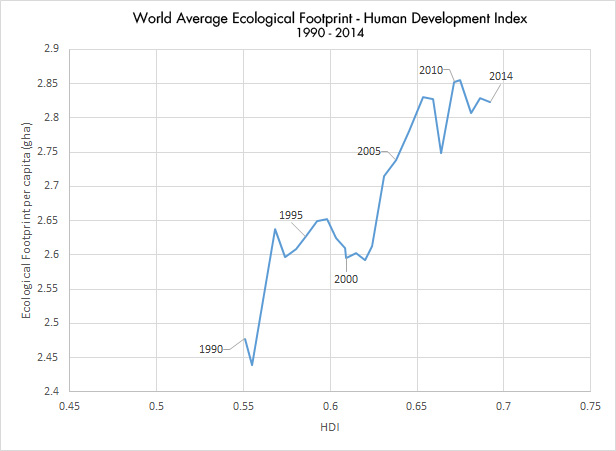
Despite such progress, the 2016 Human Development Report emphasizes that one in three people worldwide continues to live in low levels of human development.
Similarly, Footprint data reveals that ecological pictures vary dramatically country by country.
High-Income Countries
The Ecological Footprint per person for high-income countries has declined 12.9 percent since 2000. Some of the countries with the largest declines since 2000 include Singapore (-32.1 percent), the Bahamas (-26.2 percent), Denmark (-19.0 percent); United States (-18.4 percent), United Kingdom (-16.6 percent), and France (-15.5 percent).
Germany experienced an 8 percent decline in its Ecological Footprint per person since 2000 and a 2.5 percent decline in its Ecological Footprint per person from 2013 to 2014. The carbon component of Germany’s Ecological Footprint declined 6.2 percent from 2013 to 2014.
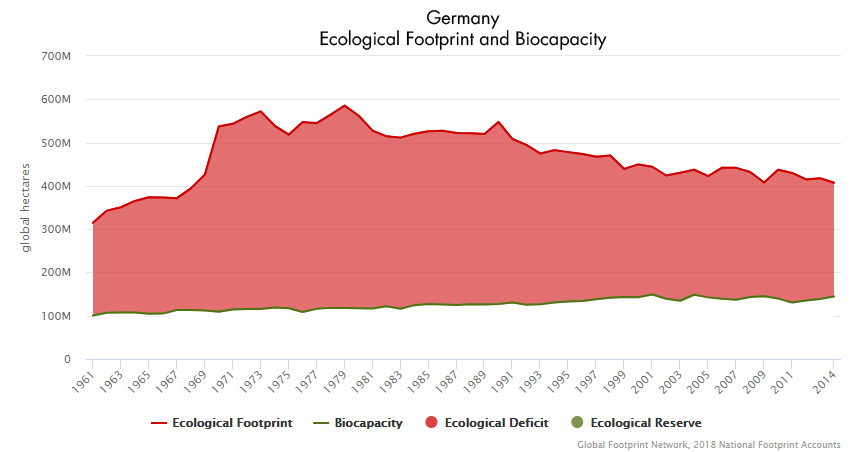
Only six countries are in the envious position of increasing their ecological reserve: Estonia, Finland, Latvia, Norway, Sweden, and Uruguay.
China Trends
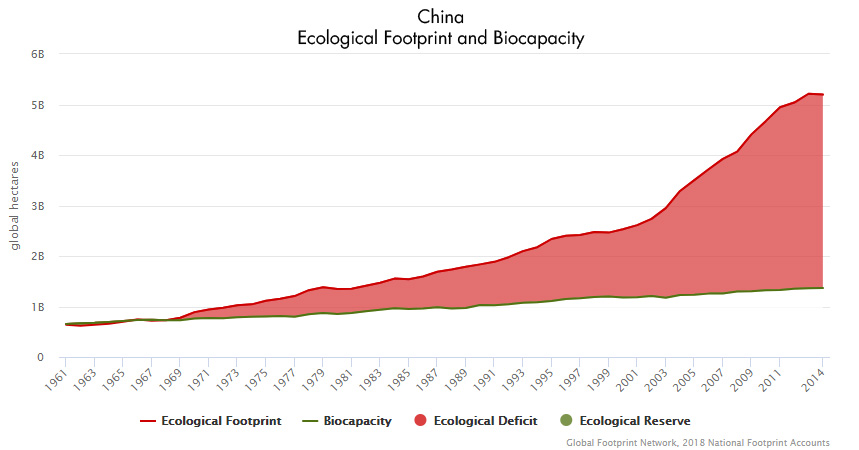
China continues to have the largest total Ecological Footprint of any country—no surprise given its huge population. The unexpected news is that China’s total Footprint actually decreased 0.3 percent from 2013 to 2014 after a steady climb since 2000, when it was half as large as it is today. China’s Ecological Footprint per person also decreased by 0.8 percent from 2013 to 2014. It is the first time these values have decreased since 2000.
The decline stems in part from a decrease in China’s total carbon Footprint by 0.7 percent and its per-person carbon Footprint by 1.2% from 2013 to 2014.
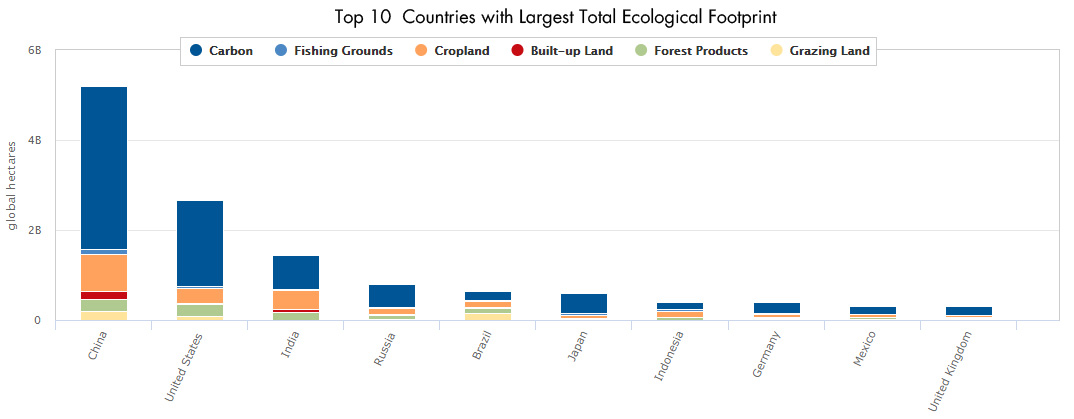
Carbon makes up the biggest portion of the global Ecological Footprint, at 60 percent. The total global carbon Footprint was about the same in 2014 as 2011, hovering at nearly 12.5 billion global hectares. This represents the area needed to sequester the carbon dioxide that the world emits into the atmosphere each year by burning fossil fuel.
Inflection Points
Two countries, both in Africa, became ecological debtors in 2014: Mali and Somalia. Bulgaria was the only country whose ecological budget moved into the black, possibly because of changes in agricultural practices.
Mali and Somalia are among 28 countries highlighted in the Public Data Package’s new sorting feature as “newly at risk,” which means they are either on the verge of running or just starting to run an ecological deficit. Other countries in this category include Botswana, Ecuador, Fiji, Honduras, Indonesia, Laos, and Nicaragua.
Footprints by the Numbers
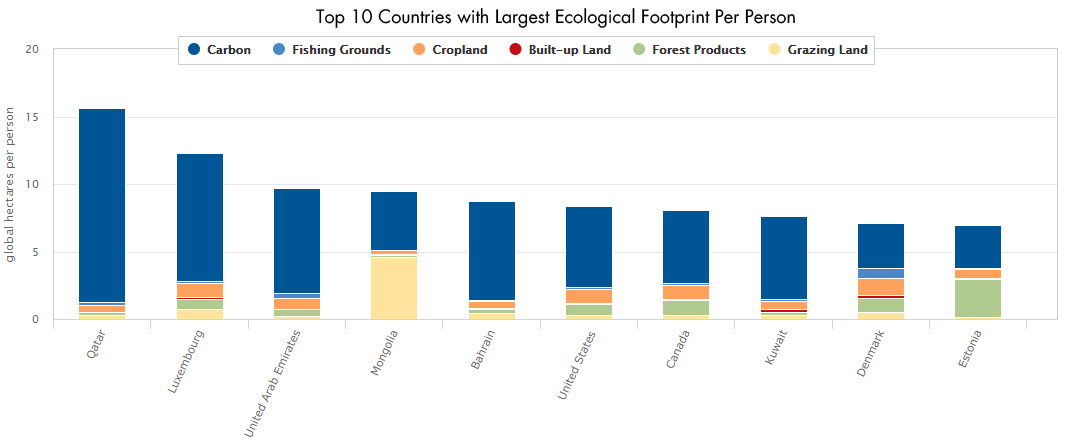
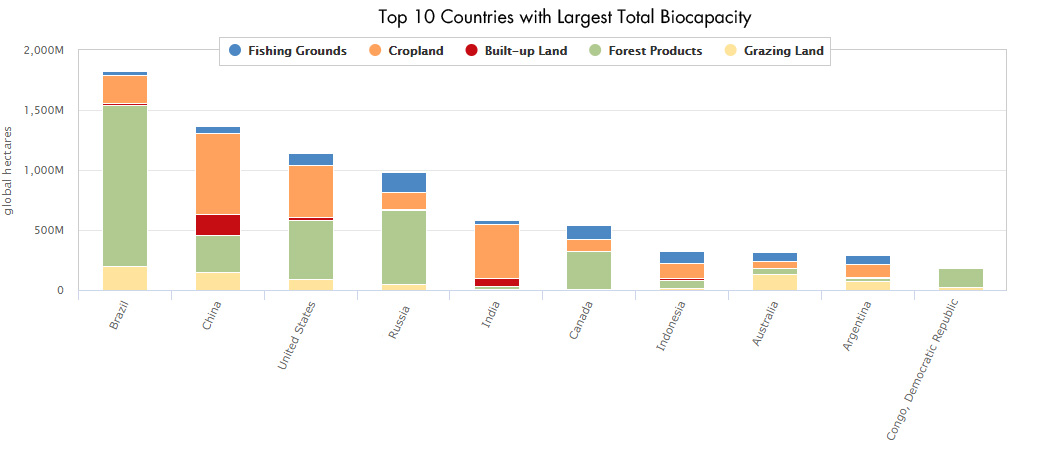
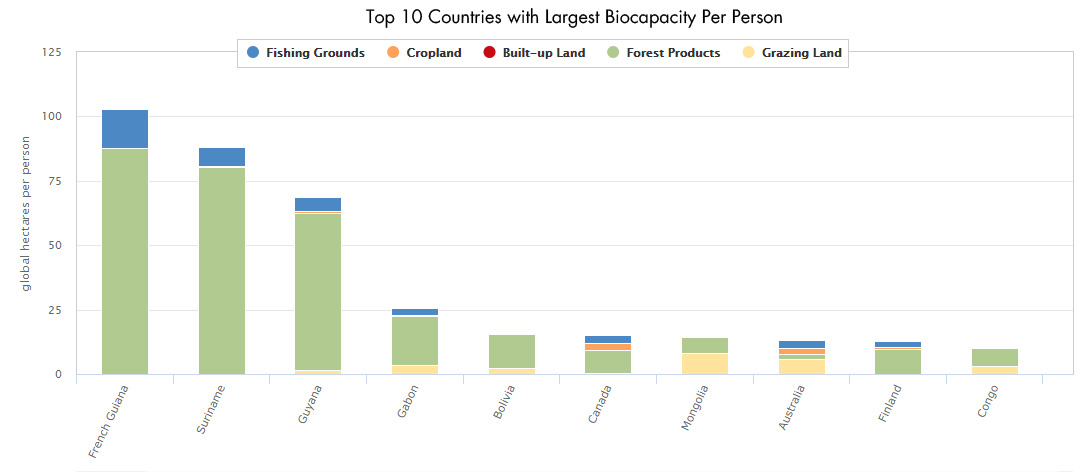
Additional Resources
Ecological Footprint Explorer Open Data Platform: data.footprintnetwork.org
Public Data package: www.footprintnetwork.org/public
Footprint Calculator: www.footprintcalculator.org
Country Work: www.footprintnetwork.org/countries
National Footprint Accounts Video: https://youtu.be/_T5M3MiPfW4
The post Has humanity’s Ecological Footprint reached its peak? appeared first on Global Footprint Network.
]]>The post How Ecological Footprint accounting helps us recognize that engaging in meaningful climate action is critical for our own success appeared first on Global Footprint Network.
]]>Tracking Climate Change Remediation
We believe that the time has never been more apt for Ecological Footprint accounting to be embraced and applied as an effective part of a comprehensive framework, that links climate to cities and countries’ competitiveness (as we spelled out in the example of Switzerland). It provides an invaluable tool to measure and track the impact of our efforts to remediate climate change, both in terms of the pressure we put on nature and of the capability of the planet to provide for these demands.
The methodology behind the Ecological Footprint is the only one that links carbon emissions to all other competing human demands on nature.
How so?
The Ecological Footprint answers a central question: How much nature do we have, and how much do we use? Life, including human life, competes for biologically productive areas. In fact, all productive areas for which various human demands compete can be added up.
This is what the Ecological Footprint does: It measures the biologically productive area needed to provide for everything that people demand from nature: fruits and vegetables, meat, fish, wood, cotton and other fibres, as well as absorption of carbon dioxide from fossil fuel burning and space for buildings and roads.
Biocapacity, on the other hand, is the productive area that can regenerate all those goods and services which people demand from nature. Comparing biocapacity to the Ecological Footprint then allows us to assess how [un]sustainable our economy is.
Since area productivity varies around the world, it is measured in a standardized unit called “global hectares,” productivity-adjusted hectares. This makes areas globally comparable. For instance, if a hectare produces only x% of the world average, it is counted as x% of a global hectare.
Through this accounting, all competing demands on nature (although not all environmental problems) can be compared. The same is true on the biocapacity side where the regenerative capacity of the land of any country or region can be compared against another.
The Carbon Footprint
The carbon component of the Ecological Footprint—which we call the carbon Footprint—measures the area of forestland that is required to absorb all the carbon emissions from human activity in excess of what the oceans already absorb (the carbon Footprint can also be expressed in tonnes of CO2 emitted). Currently, the carbon Footprint makes up 60% of humanity’s Ecological Footprint. It is inextricably linked to the other components of the Ecological Footprint—cropland, grazing land, forests and productive land built over with buildings and roads—since all these demands compete for space, as mentioned above.
Also consider: Two hundred years ago, the carbon Footprint was essentially zero. To reach the 2°C climate change target stipulated by the Paris Agreement, the carbon Footprint worldwide has to be zero well before 2050, and even earlier with a 1.5°C target.
Recognizing their own risk exposure, Ecuador included the goal to avoid sliding into ecological deficit in its national development plan, starting 2009. This is particularly interesting, because Ecuador was classified as an ” Annex II” country according to the Kyoto Protocol, exempting them from taking climate action. One of the most biologically diverse countries in the world, Ecuador was once a place where natural wealth vastly exceeded what the population demanded to support its activities and absorb its CO2 emissions. Today, that biocapacity reserve has all but evaporated. Biocapacity per person dropped from 7.6 global hectares in 1961 to 2.1 global hectares in 2014. One big driver behind the 73% loss in per person biocapacity is the 240% increase in population over the 1961 to 2015 period.
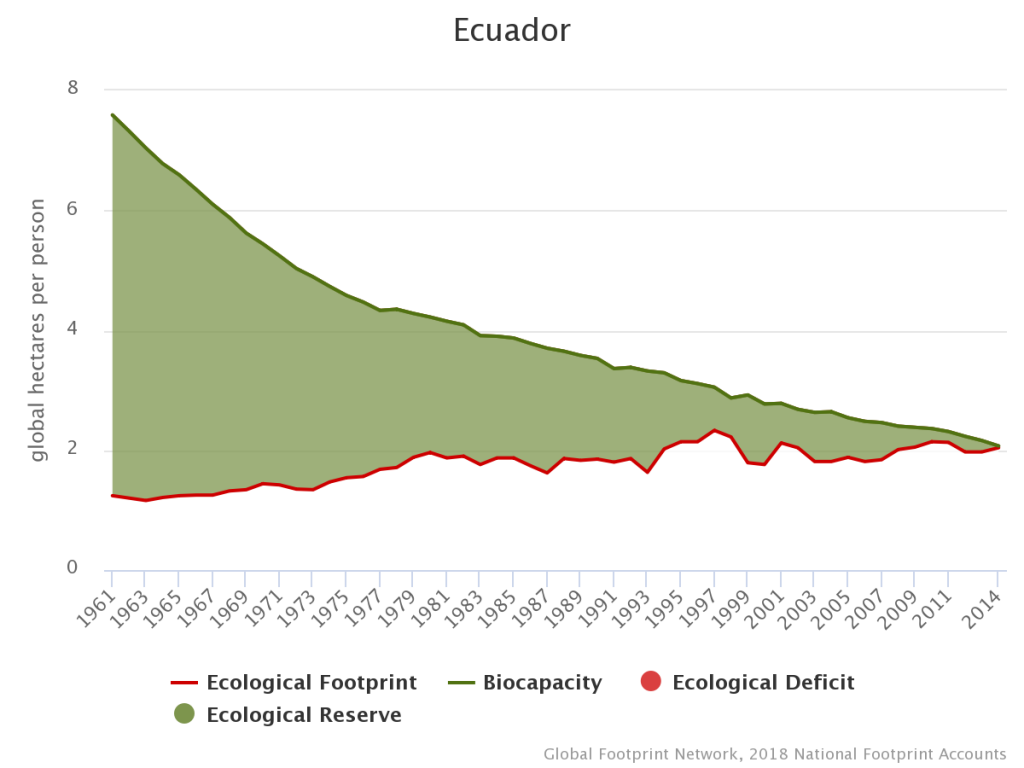
This graph shows the per person Footprint and biocapacity for Ecuador, according to the 2019 edition of the National Footprint and Biocapacity Accounts. See data.footprintnetwork.org
In 1961 (the earliest year UN data is available), the carbon Footprint of Ecuador was barely 10 percent of its overall Footprint. By today, it has grown nine-fold, on a per-person basis, and makes up more than half of Ecuador’s total Footprint. For details visit the downloadable Data Package.
“We asked, in guaranteeing the rights of Mother Earth, what would be the most comprehensive indicators we could have? The Ecological Footprint brings together multiple factors that support preserving natural wealth and recognize the impacts that consumption and development patterns have on different areas,” Dania Quirola Suarez, an environment adviser in Ecuador, said at the time of the project.
Forestlands and croplands also affect each other. Forests make up one of our most crucial ecological assets given the fact that the carbon Footprint combined with demand for forest products (paper, timber, etc.) make up a whopping 70 percent of humanity’s Ecological Footprint. Even if the whole Earth were covered with forests (which we do not advocate), we still wouldn’t have enough forestlands to meet our current demand for products and services from forests. Obviously covering the world with forests is not the answer, particularly considering that some areas are also need to grow edible crops for the 7.7 billion of us.
Again, take Ecuador: The country has lost about one-quarter of its forest biocapacity since 1961, while cropland and grazing land biocapacity have more than doubled.
Mapping the impacts of decarbonization
Mapping the world, a country, or even a city’s Ecological Footprint—its material and energy dependence on biocapacity—provides a comprehensive view of the competing material demands on our planet as the world economy tackles climate change and weans itself off fossil fuels.
For example, one of the challenges of climate change is how to reduce CO2 emissions without putting more pressure on the rest of the biosphere, for instance by increasing agrofuel production. Such a shift would not only add pressure on ecosystems but could also have significant social impact if such biofuel production competes with food crops. This underlines why a comprehensive approach is needed in order to succeed with the transformation to a carbon-free economy.
Countries and Cities’ self-interest
With all the available climate science, it becomes obvious, that the only viable path forward is an economy that lives off our planet’s regeneration, rather than its liquidation. The choice is merely how fast we get out of liquidating fossil fuels and with it Earth’s climate stability. We can go faster and comply with Paris, thereby rescuing much of our precious biocapacity (this means ceasing fossil fuel use well before 2050). Or we can go slower, still having to eventually move out of fossil fuel use, but then being left with less, and less reliable, biocapacity. Either way, it becomes clear that climate action is a question of your own resource security. In other words, if your city or your country is not getting ready for the inevitable future, your city or country will not be ready for that future. The city or country would put itself at risk. It is that simple. This also means that there is no benefit in painting yourself into a corner by continuing expanding resource dependent infrastructure and resource-intensive economic sectors. We are not stuck in a “Tragedy of the Commons” – rather we are stuck in the belief that we are trapped in such a “Tragedy of the Commons,” thereby waiting unnecessarily for others to act first. What are you waiting for?
More on Footprint, biocapacity and climate you can find here.
(updated in September 2019)
The post How Ecological Footprint accounting helps us recognize that engaging in meaningful climate action is critical for our own success appeared first on Global Footprint Network.
]]>The post Blue Planet Prize Laureates Statement: Planetary Prosperity Means Zero Carbon appeared first on Global Footprint Network.
]]>Nov. 6 – 27 is the UN COP23 Climate Conference, hosted by Fiji in Bonn, Germany.
Dec. 12 is the two-year anniversary of the approval of the Paris Climate Agreement at the UN COP21 Climate Conference.
To celebrate these milestones, 31 Blue Planet Prize Laureates joined forces to remind the world that the agreement is achievable and desirable. They declared:
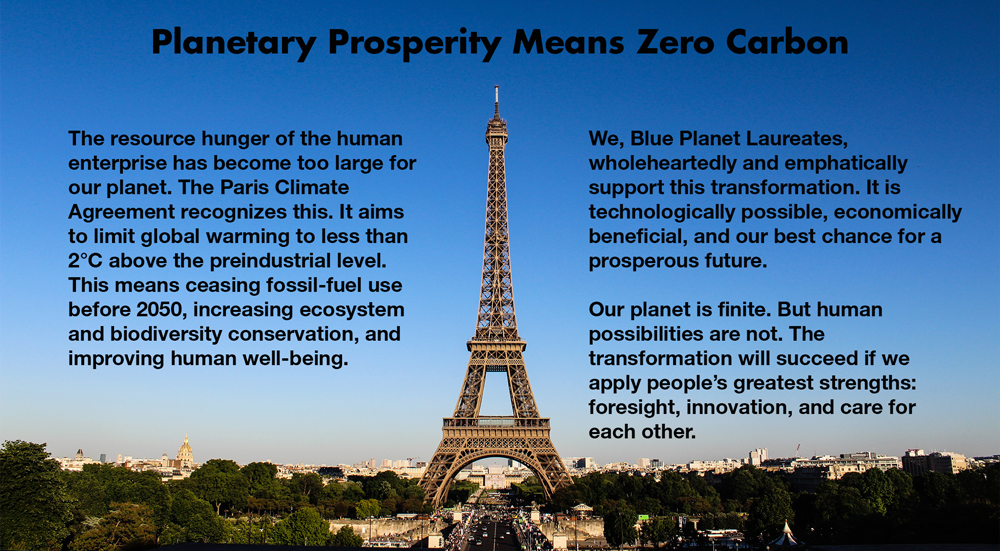
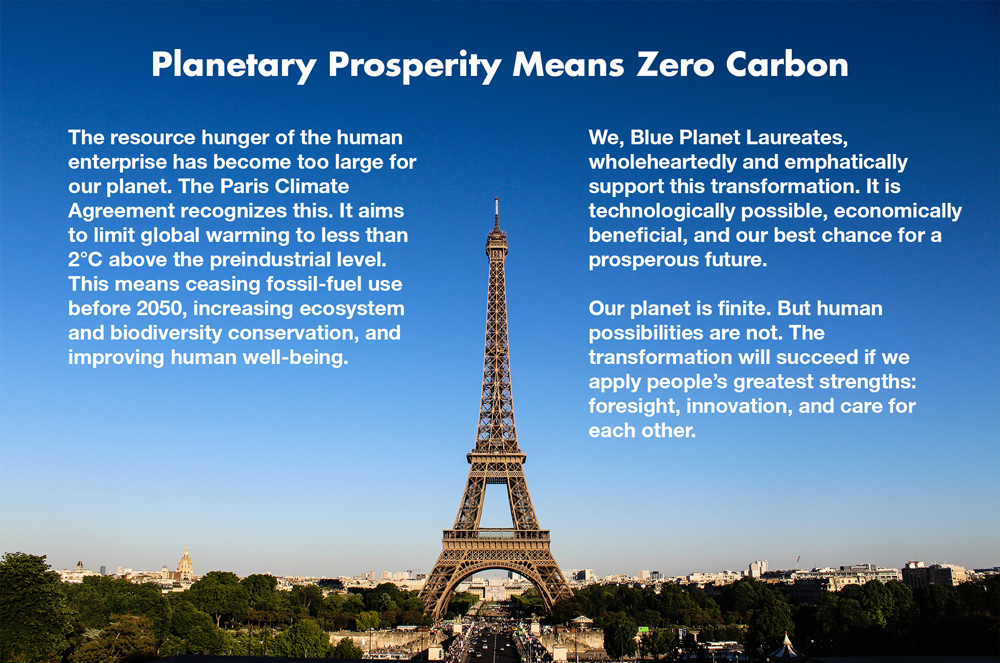
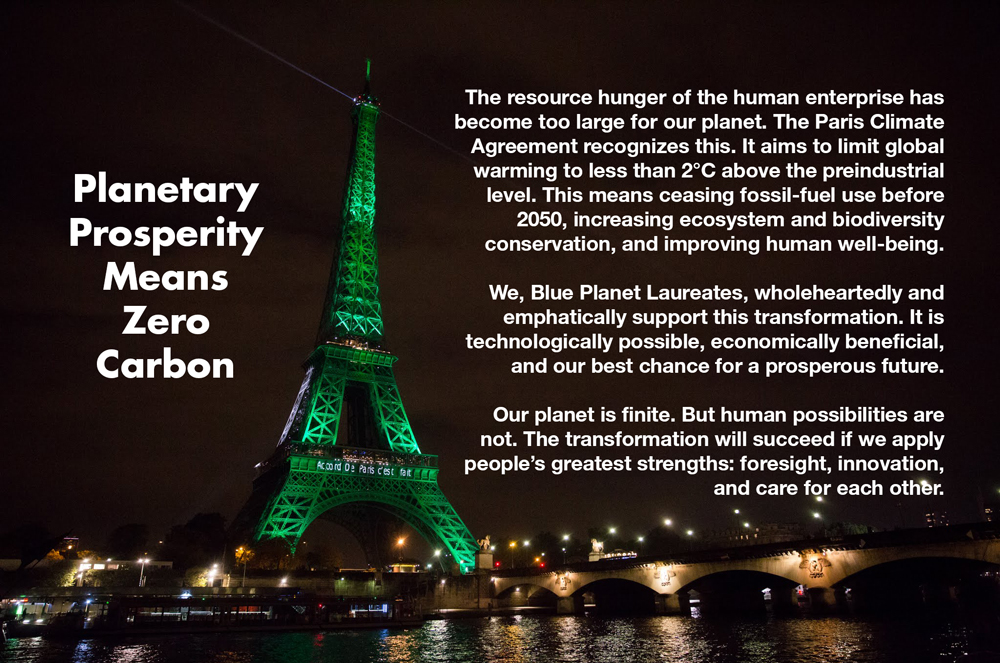
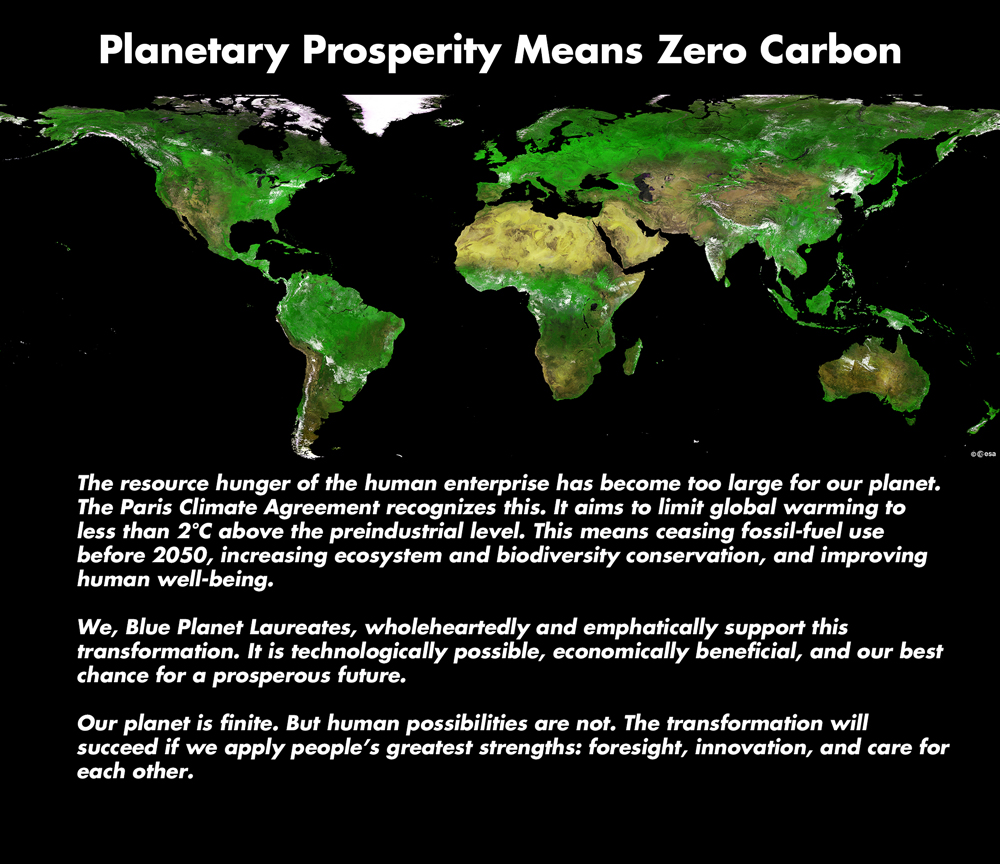
Planetary Prosperity Means Zero Carbon
The resource hunger of the human enterprise has become too large for our planet. The Paris Climate Agreement recognizes this. It aims to limit global warming to less than 2°C above the preindustrial level. This means ceasing fossil-fuel use before 2050, increasing ecosystem and biodiversity conservation, and improving human well-being.
We, Blue Planet Laureates, wholeheartedly and emphatically support this transformation. It is technologically possible, economically beneficial, and our best chance for a prosperous future.
Our planet is finite. But human possibilities are not. The transformation will succeed if we apply people’s greatest strengths: foresight, innovation, and care for each other.
In addition to Global Footprint Network CEO Mathis Wackernagel, the 31 Blue Planet Prize Laureates who launched this statement include:
| Barefoot College with Mr. Bunker Roy | Dr. Thomas E. Lovejoy |
| Prof. Dr. Markus Borner | Dr. Amory B. Lovins |
| Dr. Wallace Smith Broecker | Dr. Syukuro Manabe |
| Conservation International with Dr. Russell A. Mittermeier and Dr. Peter Seligmann | Prof. Harold A. Mooney |
| Prof. Gretchen Daily | Prof. Qu Geping |
| Prof. em. Herman Daly | Prof. William E. Rees |
| Sir Partha Dasgupta | Prof. Karl-Henrik Robèrt |
| Prof. Paul R. Ehrlich | Prof. Jeffrey D. Sachs |
| Prof. em. Jose Goldemberg | Prof. John Schellnhuber |
| Dr. James E. Hansen | Dr. Susan Solomon |
| IIED with Dr. Andrew Norton, Director | Prof. James Gustave Speth |
| IUCN with Ms. Inger Andersen, Secretary General | Mr. Pavan Sukhdev |
| Prof. Daniel H. Janzen | Dr. M. S. Swaminathan |
| Dr. Gene E. Likens | Dr. Mathis Wackernagel |
| Dr. Claude Lorius | Sir Robert Watson |
For media inquiries, please contact Ronna Kelly at ronna.kelly@footprintnetwork.org.
Please share this statement. Other images available for download:
The post Blue Planet Prize Laureates Statement: Planetary Prosperity Means Zero Carbon appeared first on Global Footprint Network.
]]>