The post Ecotourism Footprint Calculator launches today appeared first on Global Footprint Network.
]]>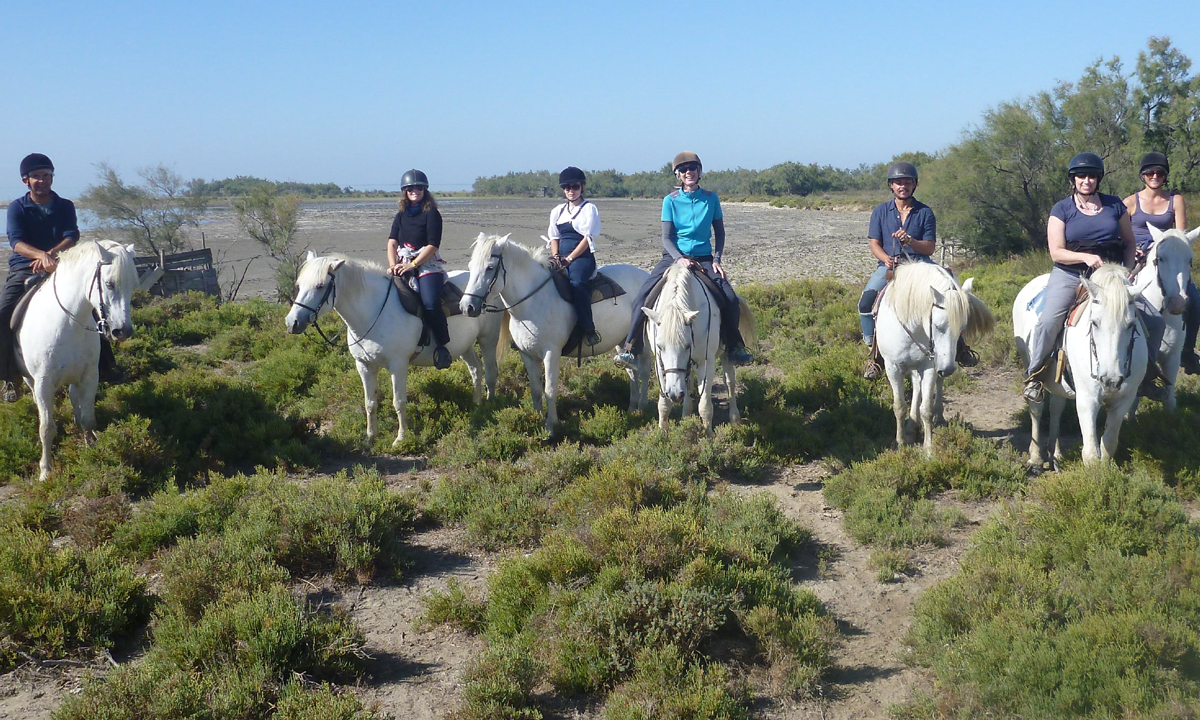
Riding horses in Camargue, France
OAKLAND, CA, USA — OCTOBER 22, 2019 — Protected Areas and tour operators can now use an industry-specific online calculator to assess and manage the Ecological Footprint of ecotourism packages. Unveiled today at an event in Rome, the Ecotourism Footprint Calculator was developed by the DestiMED Project consortium, building on Global Footprint Network’s data and methodology.
For two decades, Global Footprint Network has been providing annual metrics on natural resource demand and availability (National Footprint & Biocapacity Accounts.) Its personal Ecological Footprint calculator has been used by more than 14 million people worldwide since it launched in 2007.
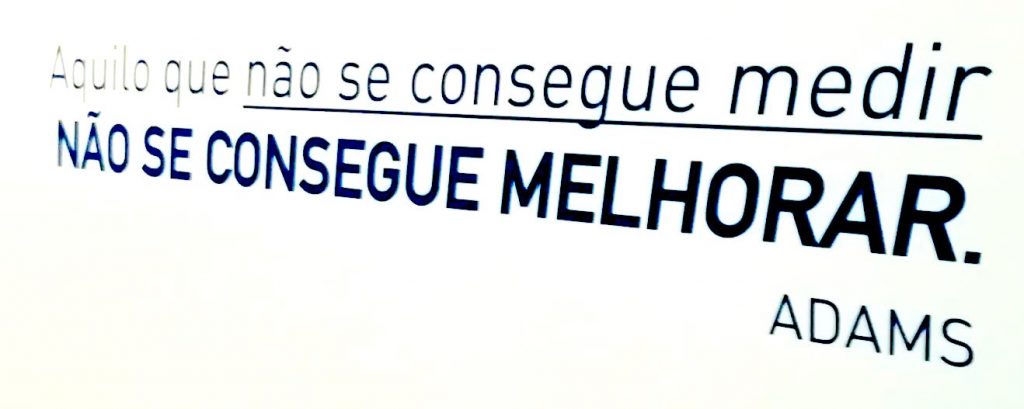
“We always say that we can’t manage what we can’t measure. We are happy to bring our natural resource accounting approach to the tourism industry, with a view to empowering managers of Protected Areas, in particular, to support the conservation of natural ecosystems via sustainably unlocking their economic value” said Alessandro Galli, Director Mediterranean and MENA Region at Global Footprint Network.
Food and beverages
The DestiMED Project was funded by the European Regional Development Fund through the InterregMED programme. Together with project partners, Global Footprint Network’s team adapted the Ecological Footprint methodology to assess the environmental impact of pilot ecotourism packages in 13 Mediterranean protected areas. Specific components taken into consideration are listed in four categories: meals, accommodations, transports, and activities. Results from the monitoring phase indicate that food and beverages have the strongest ecological impact, especially in those packages that are highly reliant on fish and meat products.
This assessment focuses on tourists’ Ecological Footprint during their stay. To evaluate the Footprint of travel options to and from the tourist destination, people can consult the personal Footprint Calculator.
“DestiMED’s Ecological Footprint methodology helped both managers of protected areas and tour operators involved in the project understand where their packages are excelling and where there is room for improvement. Moreover, new business opportunities that support local sustainable development were identified”, pointed out Carla Danelutti, DestiMED project coordinator for IUCN Centre for Mediterranean Cooperation (IUCN-Med).
Available online, the free Ecotourism Footprint Calculator is not just an awareness building or education tool. It is first and foremost a software application designed to help ecotourism professionals shape high-quality offerings with a low Footprint. The options made available to users are specifically tailored for Protected Areas.
Proof of concept to be expanded
“With this project, we focused on developing a proof of concept with ecotourism as the obvious target. Going forward, sustainability in tourism cannot be confined to the ecotourism niche, however, and will need to be expanded to the whole tourism industry,” Alessandro Galli said.
The Ecotourism Footprint Calculator is hosted and managed by the MEET Network, an association of Mediterranean protected areas developing high-quality ecotourism products that benefit conservation.
The Ecotourism Footprint Calculator and the main outcomes of DestiMED are unveiled today and tomorrow in Rome in the presence of all partners: Lazio Region (leading partner, Italy), Federparchi Association (Italy), MedPAN Network (France), the National Agency for Protected Areas (NAPA, Albania), WWF Adria (Croatia), WWF Mediterranean, and IUCN Med (International Union for Conservation of Nature Center for Mediterranean Cooperation).
Additional resources
October 22-23 final DestiMED Project event
Ecotourism Footprint Calculator
DestiMED Footprint methodology
Footprint Explorer (open data platform with Footprint and biocapacity data on all countries)
About the Ecological Footprint
The Ecological Footprint is the most comprehensive biological resource accounting metric available. It adds up all of people’s competing demands for biologically productive areas – food, timber, fibers, carbon sequestration, and accommodation of infrastructure. Currently, carbon emissions from burning fossil fuel make up 60 percent of humanity’s Ecological Footprint.
The book “Ecological Footprint: Managing Our Biocapacity Budget,” published last month, provides an in-depth introduction, drawing on the Footprint’s 30-year experience fighting ecological bankruptcy with robust resource accounting. Excerpts available for publication.
About Global Footprint Network
Global Footprint Network is an international sustainability organization that is helping the world live within the Earth’s means and respond to climate change. Since 2003 we’ve engaged with more than 50 countries, 30 cities, and 70 global partners to deliver scientific insights that have driven high-impact policy and investment decisions. Together, we’re creating a future where all of us can thrive within the limits of our one planet.
www.footprintnetwork.org
Media contacts
The post Ecotourism Footprint Calculator launches today appeared first on Global Footprint Network.
]]>The post Guimarães, Portuguese municipalities launch their city Footprint Calculators appeared first on Global Footprint Network.
]]>Portugal’s Cities Footprint project, now in its second year, launched the first city Footprint Calculator in Guimarães today. Residents can use it to assess their household’s use of natural resources and compare it with the city average. It is the first calculator available in Portuguese. It is calibrated with the specific data collected from the municipality of Guimarães during the first year of the project.
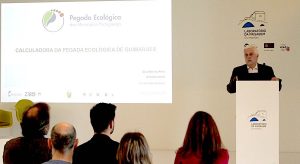
As he opened the Calculator launch event today, Dr. Seara de Sá, local councilor for urbanism (picture at left), applauded the development of Guimarães Municipal Footprint Calculator, a new and stronger communication tool that can support the municipality’s efforts to reduce its Ecological Footprint through helping citizens think globally while acting locally.
“Guimarães shows that it is moving in the right direction and this is another important step,” he said. “Instead of doing things in a generic and abstract way, we provide people with a practical tool to assess their Ecological Footprint”.
Project coordinator Paulo Magalhães of the Portuguese NGO ZERO, the local partner of Global Footprint Network, explained that the Calculator is a simple and intuitive tool that will help citizens understand the impact of their lifestyles on natural resources.
Dr. Sara Moreno Pires from the University of Aveiro, lead researcher for Portugal’s Cities Footprint project, presented the Calculator to a room full of engaged citizens. Global Footprint Network’s Footprint Calculator, which has been available since 2007 and is now provided in six languages, has had a major impact raising global awareness of the implications of consumption choices, she pointed out. With more than 2 million users every year, it has become a widely recognized environmental education tool. In this context, Guimarães Footprint Calculator, in Portuguese and with local data, brings an innovative tool with a high potential to engage local residents and politicians in understanding the actions needed to #MoveTheDate of Earth Overshoot Day and live in balance with the biological resources that are available.
The Ecological Footprint of Guimarães is 3.66 gha per person. Guimarães Overshoot Day is June 13th (date when Earth Overshoot Day would land this year if humanity lived like Guimarães’ resiudents.)
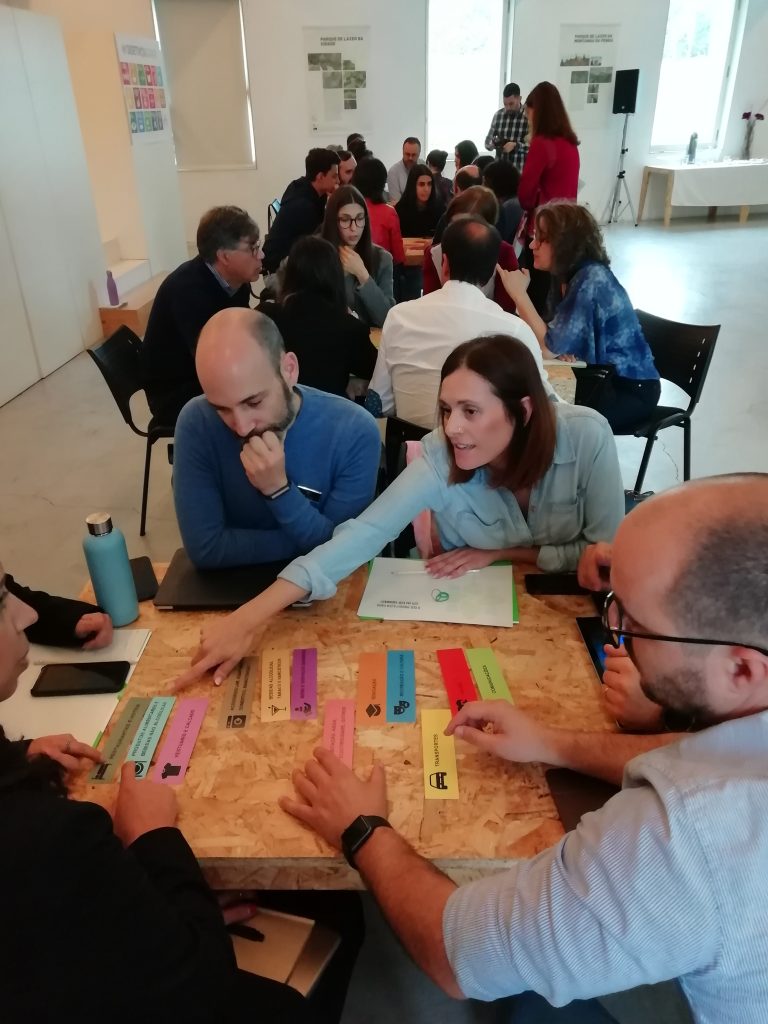
“Citizens for the reduction of the Ecological Footprint: Ambassadors of Guimarães”, a 3-hour Footprint workshop ran by Armando Alves from the research team of the University of Aveiro, followed the public presentation.
Twenty-six participants from local NGOs, schools, public agencies, other municipalities, and youth representatives, took part in several activities designed to help them understand the role of citizens in reducing the city’s Ecological Footprint and teach them strategies to disseminate Guimarães Municipal Footprint Calculator. It followed the following sequences:
- understand the Ecological Footprint and biocapacity concepts and Portugal’s Cities Footprint project
- use the Footprint Calculator as an educational and environmental awareness tool and understand its contribution to enhance awareness of the environmental consequences of consumption behaviors
- identify different contexts and target audiences for the use of the Calculator
- discuss policies and local actions critical to reducing the city’s Ecological Footprint
- implement the network of Guimarães ambassadors to #MoveTheDate.
The session was highly participative, with the trainees remaining very engaged throughout the workshop.
UPDATES
May 13, 2019: “The Ecological Footprint of Lagoa per capita is the lowest of the six municipalities that have embarked on Portugal’s City Footprinting project,” said Armando Alves, a member of the project research team at the University of Aveiro, at the launch of Lagoa’s Municipal Footprint Calculator. However “it is necessary to make all possible efforts to safeguard the natural resources that support the biocapacity of the municipality,” he added.
The event drew more than 20 people to City Hall, including several members of the local government, as well as primary and secondary school teachers. Environment Councilor Anabela Simões highlighted the importance of the Footprinting project for the local community. Project coordinator Paulo Magalhães of the Portuguese NGO ZERO, the local partner of Global Footprint Network, emphasized “the important role of Ecological Footprint Ambassadors and the involvement of civil society in the dissemination of the Footprint Calculator.”
All participants took part in the training session “Citizens for the Reduction of the Ecological Footprint: Ambassadors of Lagoa.”
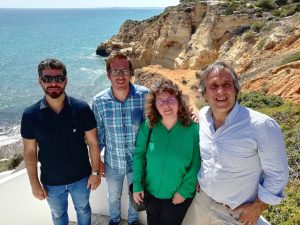
May 15th, 2019: The team of Portugal’s City Footprinting project travelled to Castelo Branco Innovative Business Centre where they were received by Castelo Branco Mayor, Dr. Luís Correia.
“The Footprint Calculator is a tool that allows each person to calculate their Ecological Footprint, based on the average data of the municipality, and to understand what influences it. This is a way of raising awareness and alerting people about their Ecological Footprint and the impacts of the consumption of the planet’s resources in their daily lives”, Dr. Correia explained to the audience.
The training workshop “Citizens for the Reduction of the Ecological Footprint: Ambassadors of Castelo Branco” was held with 12 participants, including several elected officials of local districts. Through the interactive session and lively discussion that took place on how to implement policies to #MoveTheDate, several proposals emerged to be implemented in the municipality. Those include promoting reforestation with native species and improving rainwater harvesting with ponds and watershed conservation.
Afterwards, the team opted for dinner at Nuno’s, a vegetarian restaurant in Castelo Branco, and was delighted to discover their upgraded space and the new delicious food options!
May 16th, 2019: Food is the main driver of Bragança’s Ecological Footprint, emphasized Dr. Sara Moreno Pires from the University of Aveiro at the launch of Bragança’s Municipal Footprint Calculator. “The calculator helps us assess the natural resources that are necessary for the consumption of food, transport or housing, and how small changes in our diets or mobility patterns can contribute to a significant reduction in the Ecological Footprint of the municipality.”
“Our goal is indeed to make a positive contribution for our territory and the planet,” Mayor Hernâni Dias said to the 40 people in attendance. “For this reason we are making this Ecological Footprint Calculator available so that people can voluntarily make their calculations, measure the impact of consuming more or less meat, of walking more or less time, or using the means of transport provided by the municipality to get to work.”
The training event “Ambassadors of Bragança” was run for about 30 participants from various educational institutions, IPSS’s, security forces, and NGOs. The Mayor was involved in the whole 3 hours of the session. Discussions were very lively, contributing to new ideas on ways forward on local policies as well as on needed personal behavioral changes.
The next two events will take place in Almada and Vila Nova de Gaia on May 27 and 30, respectively.
Portuguese media articles:
Watts On – Seis municípios aceitam desafio e calculam a sua pegada ecológica
RTP – Castelo Branco disponibiliza aos munícipes Calculadora da Pegada Ecológica
Diário de Notícias – Castelo Branco disponibiliza aos munícipes Calculadora da Pegada Ecológica
Viva! Porto – Vila Nova de Gaia recebe Calculadora da Pegada Ecológica
The post Guimarães, Portuguese municipalities launch their city Footprint Calculators appeared first on Global Footprint Network.
]]>The post Join us at two California Universities for Turning Green’s College Road Tour appeared first on Global Footprint Network.
]]>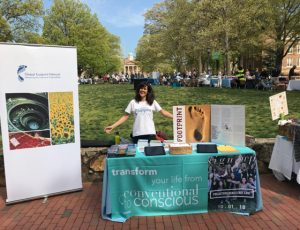 We are so excited to join Turning Green’s College Road Tour at two universities in California! Don’t miss this tabling exhibition that features sustainable lifestyle themes (Footprint, food, fashion, body, zero waste, clean, living space) and ethical samples. Stop by our table to learn more about your Footprint and how you can help #movethedate of Earth Overshoot Day.
April 26 – University of California, Santa Cruz
May 2 – University of California, Davis
The post Join us at two California Universities for Turning Green’s College Road Tour appeared first on Global Footprint Network.
]]>The post Footprint Calculator is an eye opener – Project Green Challenge Winner appeared first on Global Footprint Network.
]]>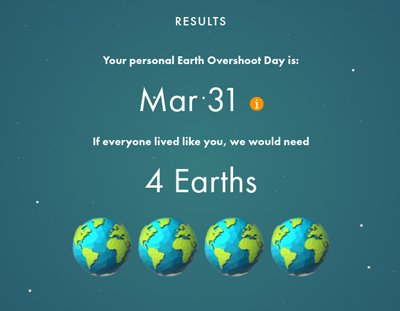 What is my Ecological Footprint? How do I measure it? These questions were answered when I was introduced to Global Footprint Network’s Footprint Calculator. The Calculator illustrated how much nature I use by showing me the number of Earths we would need if everyone lived like me. It was an eye opening experience! I could not believe more than one Earth would be needed, let alone the four that were shown as my result.
The Calculator helped me evaluate my lifestyle and discover how the choices I make impact the Earth. Where my family’s food comes from and where we buy it has the largest effect on my Ecological Footprint. Oftentimes, my family chooses to shop conveniently rather than buying local. The Calculator’s tangible solutions made me realize I could reduce my Footprint by encouraging my family to buy locally, whenever possible. We are now trying to switch from buying conventional meat to shopping at a local butcher and buy local dairy products, specifically milk. My goal is that we will reduce our meat consumption, which will lower our family’s Ecological Footprint.
After using the Calculator and learning that energy was my second largest category, I knew I needed to make some changes. I never fully realized how much I depended on cars as a means of transportation. Now, I am inspired to walk, use public transit, and carpool more often. I plan to use these transportation options instead of driving, whenever possible. Especially in the warmer months, I would love to bicycle to my friends’ houses and to my recreational activities. I will also continue to carpool to my field hockey practices. Another significant aspect of my energy use is electricity. I plan to evaluate the light bulbs in my house and change them to LED bulbs. Switching to LEDs and limiting the amount I drive will reduce my energy usage.
Global Footprint Network’s Footprint Calculator was easy to use and gave me simple, tangible solutions to reduce my Footprint on the Earth. After answering the questions on the Calculator and evaluating my results, I am committed to reducing the resources I use and making lifestyle changes to decrease my Footprint. This tool was an eye opener for me and I hope it can be the same for others. Now it is time to ask yourself…what is your Ecological Footprint?
 Bridget is a high school student in Alexandria, VA. She was a Project Green Challenge (PGC) 2017 Finalist, and is now serving on Turning Green’s PGC and Conscious College Road Tour Student Advisory Board Committees. Bridget was a founding member of the Watershed Warriors Initiative, a school club and now non-profit that educates elementary school students on environmental issues. She is involved in many activities at her school, including the Superintendent’s Student Leadership Committee, the varsity field hockey team, and the National English Honor Society (NEHS).
The post Footprint Calculator is an eye opener – Project Green Challenge Winner appeared first on Global Footprint Network.
]]>The post Be Good to the Environment in 2018 appeared first on Global Footprint Network.
]]>The post Be Good to the Environment in 2018 appeared first on Global Footprint Network.
]]>The post New Study Highlights Educational Benefits of Footprint Calculator appeared first on Global Footprint Network.
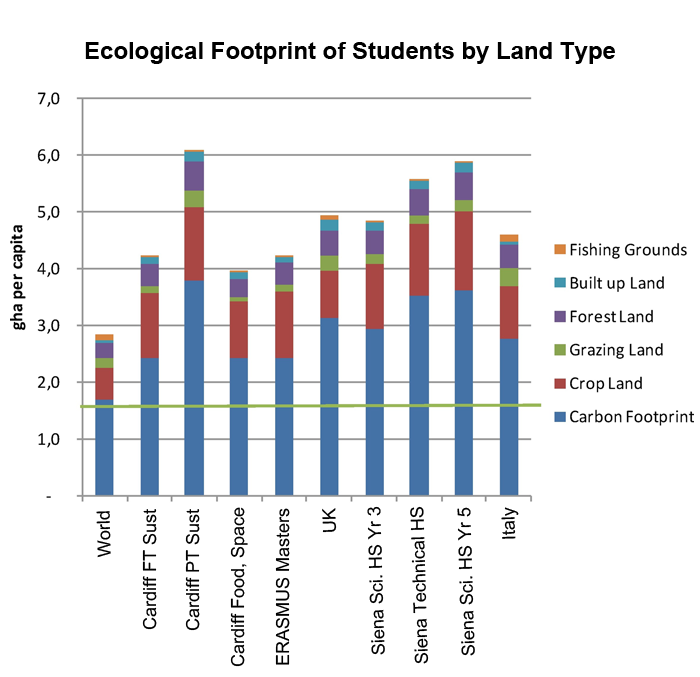
]]>A new study of the Ecological Footprint Calculator used in classrooms in Italy and the UK identified several educational benefits, including making sustainability personal for students and providing insight on how daily activities affect national and global sustainability.
The study, published online by the Journal of Cleaner Production, was co-authored by Andrea Collins of Cardiff University; Alessandro Galli of Global Footprint Network; and Nicoletta Patrizi and Federico Maria Pulselli, both of the University of Siena. The article explores, for the first time, the educational value of personal Footprint calculators and their contribution in terms of enhancing awareness of the environmental consequences of consumption behaviors.
The article outlines results from experiments with 20 postgraduate students at Cardiff University and 31 high school students attending an apprenticeship program at the University of Siena. Cardiff and the University of Siena have conducted research on the Ecological Footprint since 2002.
“By putting the sustainability debate in the context of their everyday life, as opposed to teaching abstract, intangible theories and concepts relating to sustainable development, students experienced firsthand—through the calculator exercise—the multidimensional character of sustainability and gained insight as to how the wide array of their daily activities affect the global sustainability discourse.”
After using Global Footprint Network’s Ecological Footprint Calculator, instructors facilitated an interactive class discussion in which students reflected on their results and considered ways they could reduce their Footprint. The majority of students focused on mobility decisions. Students noted that governments would need to improve infrastructure to enable them to address the mobility and housing components of their Footprints. Cardiff University students also reflected on the low use of renewable energy in the UK. Overall, students showed willingness to take small actions rather than make dramatic lifestyle changes.
Additional Resources:
Ecological Footprint Calculator: www.footprintcalculator.org
Ecological Footprint Explorer Open Data Platform: data.footprintnetwork.org
More Educational Resources:
www.footprintnetwork.org/resources/educational-resources/
www.overshootday.org/lesson-what-day-is-earth-overshootday-2017/
www.overshootday.org/kids-and-teachers-corner/what-is-an-ecological-footprint-2/
Contacts:
Ronna Kelly – California, United States
Director of Communications and Marketing
Global Footprint Network
ronna.kelly@footprintnetwork.org
Alessandro Galli, Ph.D. (co-author) – Italy
Director, Mediterranean and MENA Regions
Global Footprint Network
alessandro.galli@footprintnetwork.org
The post New Study Highlights Educational Benefits of Footprint Calculator appeared first on Global Footprint Network.
]]>The post Friends of the Footprint Calculator appeared first on Global Footprint Network.
]]>Friends of our Ecological Footprint Calculator around the world share their experiences using this popular tool as students and educators.
Join our Adopt-a-Country campaign now to add languages and country data to the calculator to educate millions more people about sustainability.

The post Friends of the Footprint Calculator appeared first on Global Footprint Network.
]]>The post How Many Earths Does It Take to Support Your Lifestyle? Footprint Calculator Teaches Valuable Sustainability Lessons appeared first on Global Footprint Network.
]]>Back in 2007, we launched the Ecological Footprint Calculator as a tool for individuals to calculate their personal Ecological Footprint, or their demand for natural resources, including their carbon footprint. Since then, the Footprint Calculator has been used 12 million times around the world, becoming a far more popular educational tool than we could have imagined. This past summer, we launched a new beta version of the calculator with many upgrades: it’s mobile friendly; uses our latest data and methodology; and features fresh, updated graphics. (See our blog post for teachers about the launch here.)
The post How Many Earths Does It Take to Support Your Lifestyle? Footprint Calculator Teaches Valuable Sustainability Lessons appeared first on Global Footprint Network.
]]>The post Sailing one’s Footprint away appeared first on Global Footprint Network.
]]>After navigating the ins and outs of our IT infrastructure for 12 years, including the recent successful launch of a new Footprint Calculator, Robert is taking a sabbatical to fulfill a lifelong dream: sailing south towards Mexico and cruising for however long the seas will have him and his life partner, Nina.
“Nina and I met at OCSC, Berkeley Marina’s sailing school, in 2003, where we were sailing instructors. She’s the one who introduced me to Global Footprint Network,” Robert says. Nina was helping Global Footprint Network start its fundraising department at the time, and the organization needed increasing and ever more complex IT help.
Robert, a fearless IT consultant, started to help Global Footprint Network, quickly growing into our indispensable, reliable, and versatile IT wizard from heaven, says Co-founder and CEO Mathis Wackernagel. “No task was too difficult, no hour too late, and no request ever unanswered,” says Mathis. “And that was always with a smile, and a deep interest in and commitment to our organization’s mission.”
Robert, a Southern California native, started sailing at age 13 with his friend Kim. “I was hooked!” he recalls with a laugh. Through the years, he’s raced dinghies and sailed to Hawaii. He even crossed the Atlantic Ocean from the Canary Islands to St. Lucia in the Caribbean in a 36-day journey that raised money for Global Footprint Network.
Back on land, Robert has been invaluable at keeping Global Footprint Network’s IT running smoothly. He’s helped chart our tech course as development of the National Footprint Accounts have become far more complex, moving from its origins as an Excel spreadsheet to a much larger database. Today, that database starts with 32 million raw data points from multiple sources, including the United Nations, and results in more than 650,000 Footprint, biocapacity, and trade data points for more than 250 countries and regions.
The past year has been particularly busy as Robert led the launch of the new Footprint Explorer Open Data Platform in the spring, followed by the new Footprint Calculator and our office move this past summer. It’s no wonder he needs to take a break, and to connect more directly with the biosphere rather than all our biocapacity and Footprint data!
“We’re scheduled to set sail next month. We have already left the house where we lived for more than a decade. We just kept our most prized possessions, which are in storage for when we come back—whenever we decide to come back,” Robert says.
Until then, they will have a far smaller Footprint. Their new home is a 1981 38-foot Hallberg-Rassy, which Robert and Nina bought in 2013 with their dream excursion in mind. With a salon (living area), a galley, two cabins, and a head (bathroom), it is designed to keep them comfortable and safe.
“We have been renovating the boat in order to make it ocean-ready: new radar, new rigging, new hatches. We also added a storm sail and a self-steering vane,” Robert says.
On board, life will be dictated by the weather and the availability of ports along the way to refuel food and fresh water reserves. Fish caught off the boat will be a staple food. Indeed, the dependence of human life on nature’s bounty will be very obvious to Robert and Nina, even without the Footprint Calculator that Robert helped build.
The adventure is to start with a six-month journey along the Baja Peninsula and into the Sea of Cortez, which is world-famous among well-traveled sailors for its rich marine life.
“This is a new chapter in our life. Sure, it’s a tad unnerving at times, but it feels like a pretty good idea at this point,” Robert says with a grin.
The post Sailing one’s Footprint away appeared first on Global Footprint Network.
]]>The post Attention educators:<br/> calculator troubleshooting appeared first on Global Footprint Network.
]]> Updated September 30, 2020
Dear Educators,
Thank you for using our Ecological Footprint Calculator in your classroom!
If you are having some problems using the calculator, we are offering you some suggestions here as well as some background on why we updated the calculator.
Troubleshooting Tips
1. Please double-check you are using the correct URL: https://www.footprintcalculator.org.
2. It is possible your school’s firewall is blocking the website and you may need to ask your IT manager to adjust the firewall to permit students to access this site. You can determine if that is the problem by checking if you are able to access the calculator outside of your school’s wifi network, by trying it on your own cellphone without connecting to wifi and instead using your wireless carrier’s network. Here are the domains that need to be whitelisted in the firewall:
www.footprintcalculator.org
api.footprintcalculator.org
geoip.footprintcalculator.org
cdn.jsdelivr.net
maxcdn.bootstrapcdn.com
For facebook (optional – site should work without these)
staticxx.facebook.com
www.facebook.com
connect.facebook.net
3. If neither of the above solve the problem, we have also heard from some teachers that the school may be blocking the Footprint Calculator because it includes social media sharing, including Facebook. We have implemented a solution to this problem and have heard positive feedback from educators who were previously not able to access the Calculator. Your IT manager also may be able to work around that issue by allowing school computers to access the site. If you still experience difficulties, please contact us at media (at) footprintnetwork (dot) org.
Why We Updated the Calculator
Our decision to update the Ecological Footprint Calculator was largely based on how much the old technology it was built in (Flash) impeded our ability to reach more people and share our message. There are 2 billion (billion!) more mobile internet users today than when we first made the calculator in 2007. We haven’t been able to serve that population, but by updating the technology we are now able to serve the dominant channel for internet use, especially for younger generations. Furthermore, even on desktops, Flash is being phased out on internet browsers, making our old calculator increasingly difficult to use. And finally, this platform made it very hard to easily update the calculator with our latest data and methodology.
Future Plans
Our intent is to continue adding content that teachers have found very valuable. This includes different country-specific information (and different languages). It also includes improving the pedagogy to highlight the importance and limits of solely individualized consumer action. Our new beta version of the Footprint Calculator is but the first iteration in a longer process of updates to achieve that purpose. They will take time and much fundraising to implement, but are in the works.
Country Calculator Work-Around
If you have used different country versions of the calculator in your lesson, we are hopeful that we have a work-around solution for you in the meantime. We have two additional resources to offer you to help students see how results differ by country:
- In spring 2017, we launched an open data platform, the Ecological Footprint Explorer, to make it easier for everyone to access our data. National Footprint and Biocapacity Accounts data is now available for download free of charge under a Creative Commons license. Once your students calculate their Footprint, you can direct them to the open data site to see how they compare to the average person in the US, and countries around the world. If they choose Compare Countries at the top navigation, they will go to this page, where they can see the average Ecological Footprint of all countries. They can also select a country or countries in the top left field to compare their personal results to other averages.
- Another resource we can offer is our interactive maps at footprintnetwork.org/maps, which present the data from our Footprint Explorer in a map format with a list under the map. Students can select the Ecological Footprint Per Person circle below the map, then click on a country to find the average Ecological Footprint per person in that country and compare their results. They can also look at the list under the map and see how countries rank.
Hopefully these resources will be helpful. We’ve received lots of feedback so far from educators—good and bad—which we are looking at closely as we continue to improve the calculator and related tools. Help us improve the Calculator to serve you better by sending your feedback to media@footprintnetwork.org.
To stay up to date on our calculator and our resources for educators, sign up for our newsletter here.
Thank you,
Global Footprint Network
The post Attention educators:<br/> calculator troubleshooting appeared first on Global Footprint Network.
]]>