The post Ecological Footprint: Managing Our Biocapacity Budget appeared first on Global Footprint Network.
]]>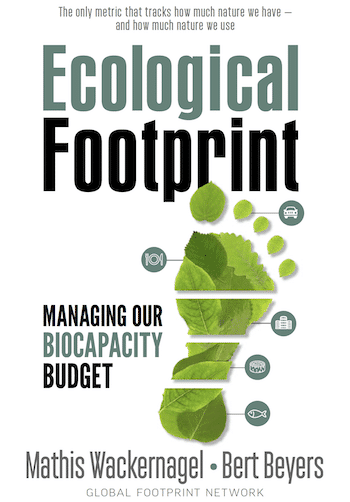
In this book, Mathis Wackernagel and Bert Beyers introduce the basic concepts, from Footprint to biocapacity and overshoot. They explain applications of this accounting tool as well as the implications of overshoot. This book is an ideal introduction to the topic.
OVERVIEW
The only metric that tracks how much nature we have – and how much nature we use
Ecological Footprint accounting, first introduced in the 1990s and continuously developed, continues to be the only metric that compares overall human demand on nature with what our planet can renew ― its biocapacity ― and distils this into one number: how many Earths we use.
Our economy is running a Bernie Madoff-style Ponzi scheme with the planet. We use future resources to run the present, using more than Earth can replenish. Like any such scheme, this works for a limited time, followed by a crash.
Avoiding ecological bankruptcy requires rigorous resource accounting ― a challenging task, but doable with the right tools.
Ecological Footprint provides a complete introduction, covering:
* Footprint and biocapacity accounting
* Data and key findings for nations
* Worldwide examples including businesses, cities, and countries
* Strategies for creating regenerative economies
Whether you’re a student, business leader, future-oriented city planner, economist, or have an abiding interest in humanity’s future, Footprint and biocapacity are key parameters to be reckoned with and Ecological Footprint is your essential guide.
AWARDS
- FINALIST | 2020 Eric Zencey Prize
- SILVER | 2019 Nautilus Book Awards: Ecology & Environment
- FINALIST | 2019 Foreword INDIES: Ecology & Environment
PRAISE
If we did to our bank account what we have been doing to the Earth’s natural capital we would have been bankrupt long ago. The planet has been extremely lenient with us but that resilience is about to give way to a natural and human crisis. This book is a loud wake up call to everyone.
— Christiana Figueres, former Executive Secretary, UNFCCC
In the nick of time, as humanity crashes up against the resource limitations of our collective twenty first century lifestyles, Ecological Footprint provides a clear eyed and accessible analysis of the challenge. With clarity and compassion, Ecological Footprint reveals both our alarming self-inflicted situation and the way forward. Wackernagel and Beyers’ well written book has the power to turn the tide.
— late Thomas E. Lovejoy, Professor of Environmental Science and Policy, Institute for a Sustainable Earth George Mason University
A superb treatment of Ecological Footprint accounting as a part of our global balance sheet. Regardless of whether you are a student, a teacher, or an economist, you will find much of substantial importance in this book.
— Peter H. Raven, President Emeritus, Missouri Botanical Garden, St. Louis
Looking for a science based practical tool to navigate your future on Earth? Here it is. Ecological Footprint provides an integrated and concrete measure of our human pressure on the Planet. We all urgently need to reconnect our lives to planet Earth and adopt a biocapacity approach to modern life, translating it into concrete steps of how each and every one of us can contribute to building resilient and sustainable societies.
— Prof. Johan Rockström, Director of the Potsdam Institute for Climate Impact Research
This excellent book helps us understand and truly appreciate Nature’s capacity to continue to provide life support for our planet and for all of its inhabitants.
— Julia Marton-Lefèvre, Former Director General, International Union of Conservation of Nature
The post Ecological Footprint: Managing Our Biocapacity Budget appeared first on Global Footprint Network.
]]>The post Listen to the Earth appeared first on Global Footprint Network.
]]>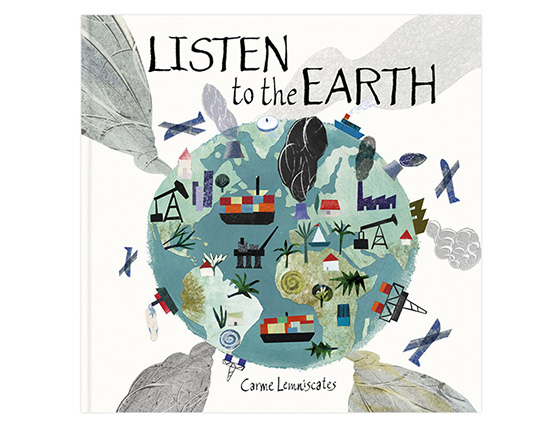 The concept of Earth Overshoot Day is featured in author, illustrator, and designer of several critically acclaimed children’s books Carme Lemniscates’ latest book Listen to the Earth. Fun children’s activities based on the book, including a coloring page and puzzles, are available for download on her website.
The post Listen to the Earth appeared first on Global Footprint Network.
]]>The post Escape from Overshoot appeared first on Global Footprint Network.
]]>The post Escape from Overshoot appeared first on Global Footprint Network.
]]>The post Encyclopedia of Tourism Management and Marketing appeared first on Global Footprint Network.
]]>The post Encyclopedia of Tourism Management and Marketing appeared first on Global Footprint Network.
]]>The post <q>How can we make the need for resource security more obvious to diverse audiences?</q> asks Mathis Wackernagel appeared first on Global Footprint Network.
]]>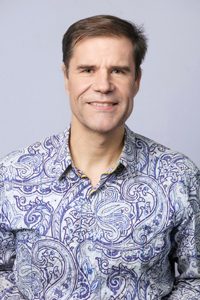
Why did you write “Ecological Footprint: Managing Our Biocapacity Budget” now?
Bill Rees and I wrote our first Ecological Footprint book in 1995 at a time when our resource-use estimates were still crude. The book summarized my Ph. D. dissertation, including a presentation of the basic premises of the idea as well as some basic applications. After this first book, I shifted strategy. I started to disseminate Ecological Footprint thinking through other organizations, including WWF, international agencies and national governments, to give it wider visibility and accelerate its mainstream adoption. Now, 25 years later, the time has come to provide an updated introduction to the whole approach. With a clear goal in mind: How to make Ecological Footprint accounting accessible, relevant, and fresh.
What are the main findings since you published the first Ecological Footprint book 25 years ago?
In 1995 we only had a rough estimate for Canada and an overly crude one for humanity. By 1997 we started to do more systematic national calculations. Global Footprint Network started in 2003 with annual updates for (nearly) every country on the planet and time series all the way back to 1961. Those accounts kept getting more and more refined. They are now so refined, as a matter of fact, that we gave them their own independent organization: www.FoDaFo.org. Back in 1995, I was expecting a faster evolution of the sustainability debate than we actually witnessed over the past 25 years. Furthermore, unsustainable trends have continued nearly unabated – from using 1.3 Earths in 1995 to using 1.75 Earths now. Most policy makers still miss or choose to ignore the fact that without resource security, humanity – and every country with it – is putting its own ability to operate at risk. And I am perpetually stunned to observe how hard it is to make this unavoidable reality obvious to wider audiences. So this has been a challenge we set ourselves: how can we make the need for resource security more obvious to diverse publics?
Can you share with us the key 3 take-away messages in this book?
- Biocapacity is the ultimate currency. Earth’s biological regeneration capacity is the most limiting of all material resources. That is why mapping all our demands against biocapacity not only makes sense but is imperative. Embracing this biological perspective allows us to clearly distinguish which strategies may be successful and which ones are doomed to fail.
- We live in unusual times. Our enormous dependence on fossil fuel seems normal to most of us. After all, “hasn’t it always been this way?” In reality, it is highly abnormal. Of all the fossil fuel ever burnt in the entire human history, 80% was burnt during my short lifetime. The book tells you how much was burnt during yours. It was 46% since Justin Bieber was born.
- It is the economy, stupid. That was Clinton’s presidential stump-speech. And he might be right on the money. In fact, we’ve been striving to make the case that embracing sustainability is economically superior and advantageous for humanity at large, starting with those who put their decision-making through a sustainability lens. Without this lens, we put our businesses, our cities, our countries even, into ever more inescapable traps.
What did you learn writing the book?
There is so much we want to tell, but ultimately including too much may not be helpful. It is more important to make the stories digestible. Bert and I challenged ourselves to translate complex ideas into examples that anybody could relate to. And to make sure the book is not just filled with theoretical ideas, but practical examples and applications. Also, when working on the acknowledgments, I started to realize how many people have contributed to this work. That is rather humbling. And I am particularly embarrassed about all the people I forgot to mention.
How confident are you that humanity’s Ecological Footprint can be brought in balance with Earth’s capacity to regenerate biological resources?
In this instance, I try to avoid thinking about probability – rather I focus on possibility. Is it possible to get out of ecological overshoot by design and not by disaster? The answer is a resounding yes. It is possible if enough people want to. It seems to me, however, that too few of us are convinced that we have personal “skin in the game” – that this context truly matters to our own lives. Fortunately, those high-schoolers boycotting school on Fridays around the world show us the way: they know that climate action is essential for their own ability to choose the life they want to live. They accuse the older generation for having failed them for a reason: too many decision makers – national and regional policy, large scale investments, urban planning – believe indeed that sustainability is merely a noble cause, not a necessary condition for prosperity. I’m afraid they are betting on the wrong horse. I predict that their blindness is undercutting their own chances at being successful. This book explains why.
MORE INFO ON “Ecological Footprint: Managing Our Biocapacity Budget“
Excerpts (brief and extended excerpts available)
Now you can buy copies directly from the publisher, your bookstores, or from any other distributor. We worked hard to keep the price low so the book is accessible to anybody. All royalties will help support Global Footprint Network.
The post <q>How can we make the need for resource security more obvious to diverse audiences?</q> asks Mathis Wackernagel appeared first on Global Footprint Network.
]]>The post Earth Overshoot Day is just one day in the year. Biocapacity feeds us every day. appeared first on Global Footprint Network.
]]> Earth Overshoot Day is not just one special day of the year. It is an effort to celebrate biocapacity — our planet’s biological power to regenerate life. This primary productivity of nature is the source for all life, including human life.
Although the term was coined in the 1990s, biocapacity is not a recent invention or a method. Like gravity, it is a force of nature that can be observed and measured.
The relevance of biocapacity is rising. Biocapacity and how we manage it is increasingly determining humanity’s future as we face the daunting challenges of climate change and resource constraints. Humanity’s poor stewardship of biocapacity has made it the most materially limiting factor for the human enterprise. Therefore, understanding biocapacity’s relevance empowers us to design cities and economies with significantly higher chances of long-term success (one-planet prosperity), while ignoring it will keep us on the business-as-usual path. We all know where the latter is headed (one-planet misery).
This, and more, is explained in Ecological Footprint: Managing Our Biocapacity Budget, published in September 2019. Twenty-five years after Mathis and Bill wrote their first book to introduce the Ecological Footprint, an update was needed to demonstrate with fresh insight how ecological overshoot is shaping the 21st century. This led to this comprehensive yet easy-to-understand book.
The book shows that the only path forward, for humanity’s sake, is to run our economies on nature’s regeneration, not on natural capital liquidation. It emphasizes that it can be done. The key tool for the job is Footprint and biocapacity accounting, applied to countries, cities and companies.
MORE INFO
You can buy copies directly from the publisher, your bookstores, or from any other distributor. We worked hard to keep the price low so the book is accessible to anybody. All royalties will help support Global Footprint Network.
Excerpts (brief and extended excerpts available)
Note to Teachers: this book is well suited for college classes, discussion groups or book clubs as it is accessible, well-illustrated, and filled with examples.
Why this book matters: Resource accounting is essential to avoid ecological bankruptcy. Learn why and how.
The post Earth Overshoot Day is just one day in the year. Biocapacity feeds us every day. appeared first on Global Footprint Network.
]]>